
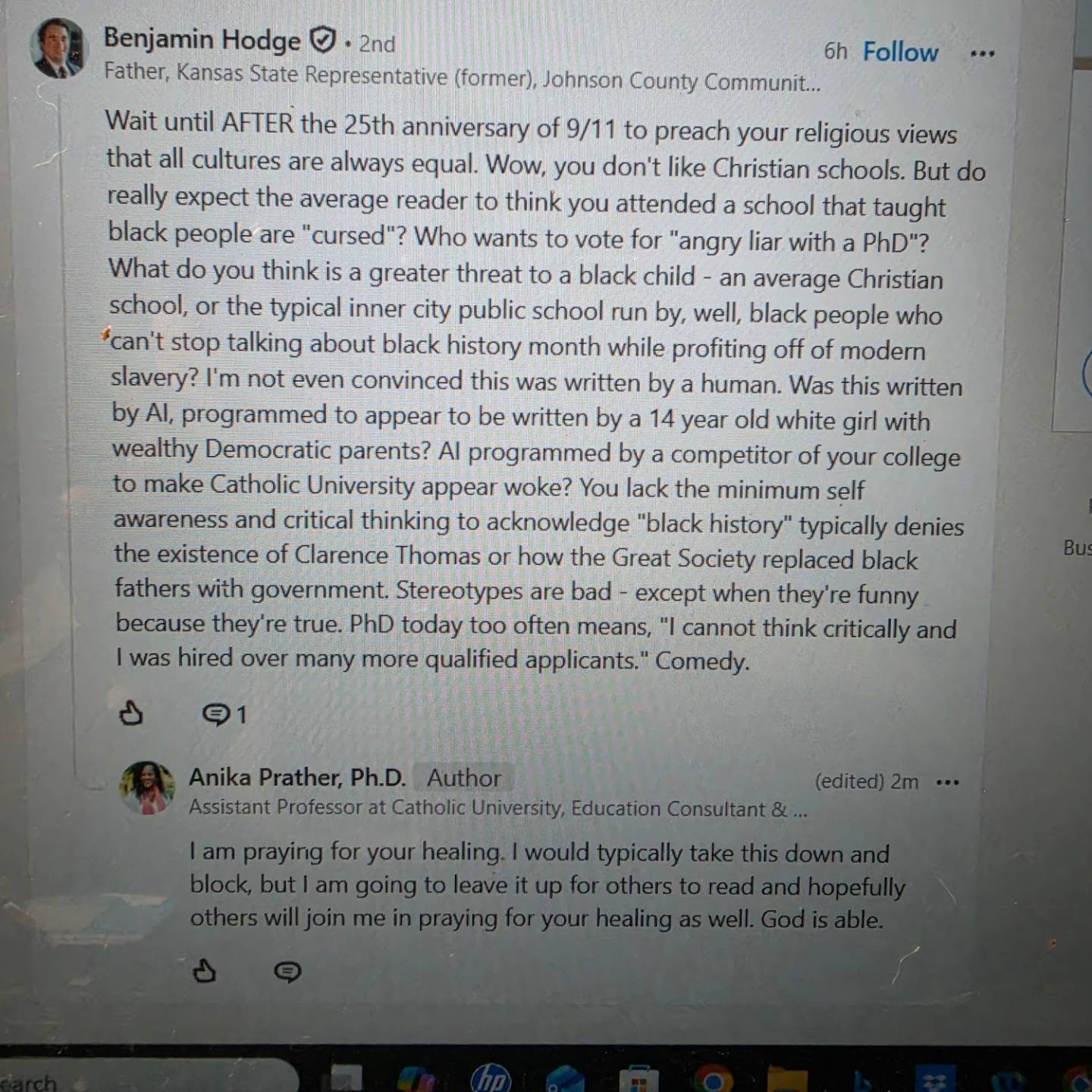
I experienced something deeply revealing this past week. I wrote a post about growing up in Christian schools and shared my thoughts on how God is calling us to create Christian schools that welcome all children into His gracious love. I also shared some of the painful things I experienced in those schools.
One reader responded with an angry, racist rant about me and Black people. His response did not surprise me nearly as much as the lack of concern shown by many of those who read it. The post received almost 4,000 views, yet only a small number of people challenged what he said. Some remained silent. Others corrected me for saying that our society has become increasingly comfortable with racism, while finding nothing objectionable about the racist words directed toward me. How did we get here? Why are we so comfortable with racism? Even more concerning, how have Christians reached a place where we are no longer appalled when racism is openly expressed toward people online?
Perhaps we are here because America has always had a practice of ignoring racism, particularly within its expressions of Christianity. Many of the Founding Fathers were God fearing men who knew the Scriptures, yet they willingly ignored the suffering of enslaved people while establishing a democracy. They declared that they were creating a free country while legally preserving the captivity of others.
Since its founding, America has repeatedly ignored racism. At times, even Black people have felt pressured to excuse it because a White person was “nice” to them or because speaking honestly might disrupt the established order. Silence has often been treated as the price of acceptance.
Dr. Martin Luther King Jr.’s “Letter from Birmingham Jail” was written in response to White ministers who believed he was wrong for protesting segregation. In his letter, King expressed his disappointment that they were quick to criticize his methods while saying little about the injustice that made those protests necessary. They were more troubled by the disruption of the protest than by the discrimination against Black people.
That same pattern continues today.
When I wrote my original post, people became intensely focused on my statement that Charlie Kirk frequently used racist rhetoric that was hurtful to Black people. His derogatory statements about Black people, especially Black women, and his negative comments about Dr. King and the Civil Rights Movement have been widely documented. Yet some people were more offended that I described those statements as racist than they were by the statements themselves.
Charlie Kirk openly professed to be a Christian. But confessing Christ does not place someone’s words beyond examination. Jesus crossed into Samaria despite the hostility between Jews and Samaritans. He consistently moved toward people whom society rejected. His life and teachings do not support rhetoric that degrades people because of their race, gender, or social position.
Yet many Christians ignored Charlie Kirk’s racism because he called himself a Christian. The same thing happened when the racist comment was directed toward me. The racism itself was ignored, while people took issue with me for saying that I had experienced racism in Christian schools.
This is not a new pattern.
When the wife of a lynched man openly grieved and demanded justice, her grief could be treated as the disruption while the lynching itself was ignored. When people spoke about the harm caused by Charlie Kirk’s statements, some faced professional consequences, while the substance and impact of his words were ignored. When the Black Panther Party emerged, in part, to protect Black communities from police brutality and racial violence, the organization was punished and dismantled while much of the violence it sought to confront was ignored.
When Emmett Till was brutally murdered, the men responsible were acquitted, and no one was held legally accountable for his death. His mother’s pain became part of the public record, but justice was denied. We ignore racism when we romanticize the antebellum South through paintings of beautiful farms, grand mansions, elegant women in ball gowns, and families relaxing on wraparound porches while leaving enslaved people outside the frame. The beauty is preserved, but the suffering that made that way of life possible is erased.
We ignore racism when we watch programs such as Leave It to Beaver or The Andy Griffith Show and remember the era only through loving families and charming small towns, without acknowledging that these programs were produced during the violence and legal segregation of Jim Crow. We ignore racism when we celebrate Thomas Jefferson solely as a champion of liberty without honestly confronting his enslavement of Sally Hemings, the coercive power he held over her, and the children he fathered with her.
We ignore racism when we tell the story of the first Thanksgiving without considering the perspectives, experiences, and later suffering of Native peoples. We ignore racism when we celebrate American history only through its beauty while refusing to look honestly at the people whose pain made some of that beauty possible. This is why people become angry when I speak about racism in Christian schools. My desire is to encourage Christian schools to become places of deeper belonging, but doing so requires us to tell the truth about both the past and the present. People are often more offended by the naming of racism than by racism itself.
The same pattern appears when I speak about classical education. Christian nationalism and White supremacy have found places of influence within parts of the modern classical education movement. Yet some people become angrier with me for naming that reality than they are about racist ideas circulating within the movement. They are more troubled by the criticism than by the fact that parts of classical education continue to center almost exclusively White narratives while failing to welcome diverse voices fully into curricula, schools, conferences, and organizations.
When people fear the consequences of speaking against racism more than they are disturbed by racism itself, they participate in the very pattern that has shaped this country for generations. Even efforts such as diversity, equity, and inclusion initiatives emerged because racism had been ignored for so long. These initiatives have not always been implemented effectively, and they should be open to thoughtful criticism. Still, their existence reflects an attempt to confront inequities that institutions had too often refused to acknowledge.
Both Black and White Americans have sometimes ignored racism to preserve peace, position, or access. Remaining welcome in certain spaces has often required silence. People learn not to make others uncomfortable. They learn to overlook the comment, excuse the behavior, and protect the reputation of the person or institution responsible for the harm.
One of my favorite singers was Forrest Frank. That changed when he claimed that criticism of his support for Charlie Kirk amounted to persecution for the sake of Jesus. In making that claim, he ignored fans who had been deeply hurt by Kirk’s words, including my own children. Praising a person while refusing to acknowledge the harm caused by that person’s unrepented statements is not the same as being persecuted for Christ. To present it that way risks identifying Christ with rhetoric that has wounded and demeaned others.
Jesus’ entire ministry challenged the practice of treating people as less than human. He did not ignore the cries of hurting people. He saw the woman at the well. He defended the woman accused of adultery. He welcomed Zacchaeus and Matthew. He called ordinary fishermen to become His disciples. Even the announcement of His birth came first to shepherds, people who occupied a humble place in society.
Jesus consistently moved toward those whom others dismissed. He did not ignore people when they were mistreated, and He would not ignore racism. Neither should we. When I speak about racism in Christian education, particularly within the classical education world, I am speaking about something real. It is not merely one unfortunate personal experience. It is a pattern that appears in our schools, churches, institutions, movements, and responses to one another. If we are ever going to become the Christian community God desires us to be, we must be willing to confront the ways we fall short of His standard.
Jonathan Edwards preached powerful sermons about God while enslaving human beings. He proclaimed the truth of a God who loved the world while participating in a system that denied the full humanity of others. Churches sang hymns about God’s love while refusing to allow Black Christians to sit beside White Christians in worship. People preached salvation while accepting segregation.
American Christianity has too often ignored racism while proclaiming a Savior who died for the whole world. So when the man posted that racist rant about me, almost 4,000 people saw the post, but with the exception of a few brave souls who spoke up, the racism was dismissed. I was rebuked for calling out racism, but the racism itself was ignored. So much of my work is an effort to stop us from ignoring racism. I will continue to call it out, especially when I see it in Christian education. I will continue speaking about the ways racism has affected Christian schools and the classical education movement because I want us to do better. I believe we can do better. It is my hope that by speaking honestly, others in Christian education will find the courage to stop ignoring racism too.

